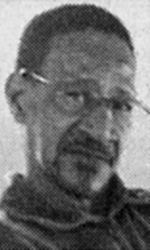
Ronnie White
Ronnie White
On the sidewalks, at the bank, on the corner of Main and Depot, coming out of Pat's Place, at the post office, or having a smoke in front of Chatham Furniture, a passerby could often see Ronnie White at one of those spots — or on his way and walking fast to get there.
That's the way it was with Chatham and Ronnie White for a good 50 years.
“You couldn't go to Chatham without seeing Ronnie somewhere,” recalled the Reverend Roger Williams in his eulogy at the Greater Triumph Missionary Baptist Church on Monday. “If he wasn't somewhere on Main Street, you'd see him standing in the window of the furniture store and looking out at Main Street.”
What Ronnie loved most beyond his family and his little dog Louie is anyone's guess. But Chatham was his town. He cherished its people and their oddities, and he had a powerful knowledge of family connections — both black and white. He knew where people lived, where they used to live, and what they had done — both good and bad.
For the past 36 years, Ronnie was part and parcel of a remarkable duo — himself and J. W. Thomasson — at Chatham Furniture Company. They beat all the doom-and-gloom odds and kept right on selling furniture and making their livings on Main Street while other merchants bellied up, blaming their demises on the plague of the Big Box stores within easy driving distance.
Before that, Ronnie spent years with Chatham Furniture when it was owned by Claude Emerson and Percy Bennett.
For all the years I knew Ronnie and enjoyed his company, the last five were the best. I had opened a book shop next to the furniture store and, on slack afternoons, could go next door and settle into one of the nice leather sofas facing Main Street.
Ronnie and I would sit there and watch the people coming and going at the post office — remembering things we knew about some of them and expressing indignation over how many of them were rank strangers. In that setting, one story always leads to another, taking you down all the delightful paths of your memory.
Ronnie had a gruff dignity about him that could put you off until you realized that lurking just beneath the surface was an exuberant good humor. He delighted in the small gem at the heart of a personality, the tiny defining anecdote that revealed a person's character. And he had a gift for homing in on them. He was just great fun to be around.
He also had a marvelous child-like curiosity. One day, during his long association with various medical problems, Ronnie pulled up his shirt to show me an amazing contraption a doctor at UVa had attached to him to monitor some arcane activity in his body — and then transmit the pertinent information back to the doctor in Charlottesville.
Neither of us had ever seen anything like it. So we got to examining it and looking at all the strange gadgets that had come with it.
“Looka here!” Ronnie said, handing me a piece of gleaming metal. “Says this thing was made in Israel! Why in the world do you reckon they couldn't make it here?”
That, of course, is a question that runs through the furniture business as well as nearly every other aspect of American manufacturing. Ronnie was astonished that this pervasive economic problem had invaded even his own body.
Under the gruff exterior, according to his devoted family members, Ronnie had a soft spot for the Lord. Once, when he had come through some very dicey surgery, he told me that his surgeon in Danville had informed him just before the operation that the odds for success were not good. The doctor said that as a surgeon, he needed all the help he could get. So the surgeon led them in prayer, and indeed that medical problem was rectified.
Ronnie took considerable satisfaction in this experience — the fact the surgeon admitted he needed help, the fact he was intelligent enough to ask for help, and the fact he got it.
Well over 300 people were at Ronnie's funeral on Monday to hear joyful music and eloquent eulogies for a man who was loved by so many. What defined Ronnie, one speaker said, was that “he led a completely non-pretentious life.” She had it about right.
Although Ronnie was a life-long walker and not a driver, one eulogist drew a picture of Ronnie on his way to Heaven, going up the big highway and seeing a toll booth up ahead.
Then we see Ronnie scrambling to find the right change so he can get through the toll booth, worrying about whether he has the coins he needs. When he reaches the toll booth, he's still scratching around looking for the right change.
“Hold on, there, Ronnie,” the toll-taker says. “Fellow came through before you and already paid your toll. You just go right on through.”
I think Ronnie White would have liked that, though he would not make a big thing out of it.
This website is sponsored by Mitchells Publications, Chatham, Virginia.